3.6) Extending the variable charge on an electron concept
If we consider the possibility of an infinitely variable charge on an electron and extend this model to fit common components, then everything still fits.
In paragraph 1.1 it was stated that the mass of an electron is 9.109 x 10⁻³¹ kg i.e. it is a constant mass for all electrons. If the voltage is infinitely variable in relation to another potential, then the charge in relation to this potential is also infinitely variable but proportional to the voltage.
Volts ∝ Charge per Electron in Coulombs
As Volts have been set at a finite charge on the electron, then we can include a constant to obtain:-
Voltage = Charge per Electron x k1 Volts
The quantity of electrons over a time period is then represented by the current such that :-
Current ∝ Electrons per second
As Amps have been set at a finite number of electrons then we can include a constant to obtain:-
Current = Electrons/s x k2 Amps
Note that the time period is omitted from the dimension Amps, in the same way time is omitted from the dimension Hertz (which represents cycles per second).
The rate of flow of power then becomes the number of electrons x the charge on each electron or :-
Watts = Amps x Volts
It then becomes obvious why a higher current requires a thicker wire. A greater cross-sectional area is required to carry the greater number of electrons. The model fits exactly and Voltage and Current now make sense.
3.7) Applying variable charge on an electron to resistors
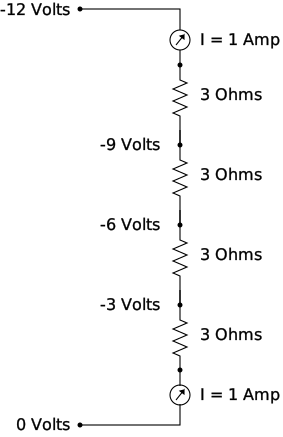
If the variable charge electron is applied in relation to the current flowing through a resistor then again the resulting behaviour is simple and logical. A resistor chain of 12 Ohms is placed across a -12 Volt supply. as in figure 9. and the current passed is then 1 Amp (simple Ohms law). Assume that the current meters do not have a voltage drop and then the potentials at the resistor junctions are -9, -6 and -3 Volts.
Figure 9 Electron Flow in a Resistor Network
It is quite clear that the current, or number of electrons going into and coming out of the resistor chain is the same because both ammeters read 1 Amp. The voltage has, however, dropped within each 3 Ohm resistor showing that charge has been given up from the electrons to the resistors (in the form of heat). When the electrons reach the 0 Volts connection, all of the charge in relation to 0 Volts has been dissipated but the electrons are still present. Electrons without charge? Could this be the explanation for the mysterious missing dark matter that astronomers cannot find?
3.8) Applying variable charge on an electron to capacitors
When the concept of an infinitely variable charge on an electron is applied to capacitors, the model still works. The larger the surface area of the plates in a capacitor, the greater its capacitance, because there is more area for electrons to be emitted. The greater the value of the dielectric constant, the more the movement of electrons is restricted to move between the surface of the plates. The closer that the plates are positioned the easier it is for the electrons to pass from one to the other.
THIS PARAGRAPH TO BE COMPLETED AT A LATER DATE.
4.0) Conclusions
It seems that there are lots of holes in our knowledge of electrons and electricity but the description of a charged particle travelling at the speed of light fits nicely into the description of the mechanism of most components. Even to the point where one can consider the ballistics or trajectory of such a particle in an antenna, microwave pcb layout or a cable. There are some long-held beliefs that really do need revising if we are to make a cohesive explanation of electricity. Updating our knowledge would enable lecturers to convey logical concepts without being reduced to using inappropriate analogies to convince confused students that component behaviour is different to reality. More efficient components could be designed using the new understandings. The present layers of knowledge built upon these basic concepts can be improved and simplified, and the science of radio frequency electricity, transmission lines, antennas and probably light can move on to a higher level.
My present thinking is that Edison was right that the charge on an electron is infinitely variable but then that thinking may change again if somebody can produce solid contrary evidence!
Technical Articles Index First Published on 21/10/2026 by William J Highton